
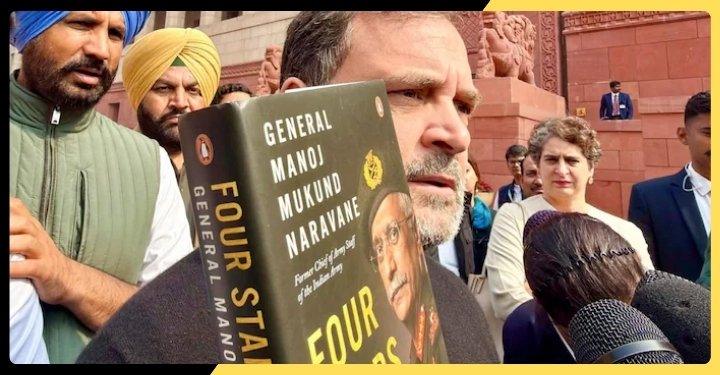
Denials are usually meant to end conversations. In the case of the alleged memoir by former Indian Army Chief General M.M. Naravane, the opposite has happened. The publisher’s firm insistence that no such book exists has only intensified scrutiny, turning what might have been a quiet publishing matter into a public puzzle.
What makes this episode unusual is not merely the denial itself, but the confidence of those who contradict it. Journalists have gone on record stating they saw the manuscript or were briefed on its contents. Their descriptions align in tone and structure, suggesting a shared reference point rather than speculation. This is not the fog of rumor; it is the friction of competing certainties.
In normal circumstances, such contradictions are resolved quickly. An author confirms or denies. A publisher clarifies timelines. Here, neither has happened. The result is a vacuum, one that has been filled by conjecture about why a book—particularly one by a former Army Chief—would be so carefully disowned.
The sensitivity of military memoirs offers one clue. Even when written with discretion, they operate in a politically charged environment. Every reflection is read for implication. Every anecdote is examined for what it reveals about command culture, decision-making, and accountability. In India, where the military’s public image is closely guarded, the margin for misinterpretation is slim.
Sources familiar with the matter suggest the manuscript may have been completed—or close to it—before concerns emerged. These concerns may not have been about factual accuracy but about reception. How would the book be used in public debate? Would passages be selectively quoted to support competing narratives? Would silence have been safer than explanation?
From the publisher’s standpoint, denying existence may have been the cleanest exit. Acknowledging the project and then explaining its cancellation would invite further questions: Who objected? What changed? Why now? A flat denial avoids those inquiries, even if it strains credibility.
For General Naravane, the calculus may be different. Speaking could legitimize the controversy. Remaining silent allows it to dissipate—eventually. Military culture values restraint, and that instinct may outweigh the desire to set the record straight in a media storm.
Yet the story persists because it touches on something larger than one book. It reflects the tension between transparency and control, between public curiosity and institutional caution. It also highlights how information, once partially revealed, resists being fully withdrawn.
The irony is hard to miss. A memoir that may have aimed to offer calm reflection has instead generated uncertainty. A denial intended to close a chapter has opened several new ones. And a book that readers cannot buy has nevertheless shaped conversation.
Whether the manuscript still exists, whether it will ever be published, or whether it will remain permanently unseen are questions only a few people can answer. Until they do, the book remains in a strange limbo—neither confirmed nor convincingly erased.
In the end, the controversy may be remembered less for what the book contained and more for what its disappearance revealed: that in the modern public sphere, absence can be as powerful as presence, and denial can sometimes be the loudest statement of all.