
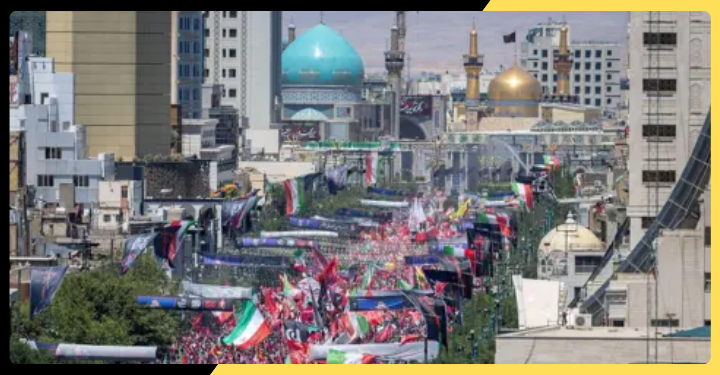
Mashhad, Iran: Iran brought days of national mourning to a solemn close as vast crowds gathered in the holy city of Mashhad for the burial of the country’s late Supreme Leader, Ayatollah Ali Khamenei. The funeral marked the final stage of an extensive series of memorial ceremonies that traveled through several Iranian and Iraqi cities before concluding at the Imam Reza Shrine in Khamenei’s hometown. The event drew hundreds of thousands of mourners, senior government officials, military commanders, religious scholars, and foreign delegations, making it one of the largest public gatherings in the country’s recent history.
People began arriving in Mashhad several days before the burial, traveling from every province of Iran. Buses, trains, and private vehicles filled highways leading into the city as authorities introduced special transportation services to accommodate the unprecedented number of visitors. Hotels, religious guesthouses, and public accommodation centers reached full capacity, while schools and community buildings were temporarily opened to host pilgrims attending the ceremony.
The streets surrounding the Imam Reza Shrine were decorated with black mourning banners, Iranian flags, and portraits of the late Supreme Leader. Thousands of volunteers distributed drinking water, meals, and medical supplies to visitors waiting along the funeral route. Religious hymns, Quranic recitations, and prayers echoed through the city as mourners gathered peacefully to pay their final respects.
Security arrangements were among the largest ever implemented in Mashhad. Thousands of police officers, members of the Islamic Revolutionary Guard Corps, and emergency personnel were deployed throughout the city. Security checkpoints were established around key intersections and entrances to the shrine complex, while surveillance systems and helicopters monitored crowd movement to ensure public safety. Medical teams remained on standby throughout the ceremony to respond to emergencies caused by the large gathering and high temperatures.
The funeral procession began with prayers led by senior clerics before the coffin was carried through designated streets toward the Imam Reza Shrine. National television broadcast the event live, allowing millions of Iranians across the country to follow the ceremonies. Government offices, educational institutions, and many businesses suspended normal activities as the nation observed an official period of mourning.
President Masoud Pezeshkian, senior cabinet ministers, military commanders, and prominent religious leaders attended different stages of the funeral. Representatives from several allied nations also participated in memorial events, reflecting Iran’s diplomatic relationships across the region. Speakers described Ayatollah Khamenei as one of the most influential figures in the history of the Islamic Republic and praised his leadership during periods of war, sanctions, and regional tensions.
The Imam Reza Shrine was chosen as the burial site because of its deep religious importance and its connection to Mashhad, the birthplace of the late leader. Many mourners described the location as a fitting final resting place, combining spiritual significance with personal history. Pilgrims continued offering prayers inside and outside the shrine long after the official burial ceremony had concluded.
Throughout the procession, many participants carried flowers, religious flags, and handwritten messages expressing gratitude and respect. Families attended together, while university students, veterans, religious scholars, and community organizations marched in organized groups. Volunteers worked continuously to provide assistance to elderly visitors and those requiring medical attention.
The funeral also highlighted the political importance of the moment. Officials called on citizens to remain united during the leadership transition and emphasized continuity within Iran’s political and religious institutions. The large turnout was presented by state authorities as a demonstration of national solidarity during a period of regional uncertainty.
International observers closely monitored the ceremony, viewing it as an important moment for Iran’s future. Analysts suggested that the orderly organization of the funeral reflected the government’s efforts to project stability despite continuing economic challenges and geopolitical tensions. The event also attracted significant global media attention because of its political and religious significance.
As the final prayers concluded inside the Imam Reza Shrine, mourners slowly departed from Mashhad, bringing an end to nearly a week of national remembrance. The funeral closed a defining chapter in Iran’s contemporary history while opening a new period under the country’s new leadership. For many Iranians, the burial represented not only a farewell to a long-serving leader but also a moment of reflection on the nation’s future direction amid changing regional and international circumstances.