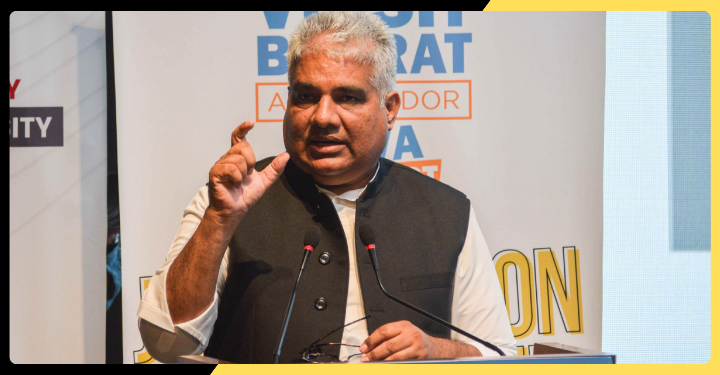
The Central Government has carried out a fresh administrative reorganization in the office of Union Minister Bhupender Yadav, resulting in the removal of his Private Secretary and two Additional Private Secretaries. The development marks a significant reshuffle within the minister’s personal establishment and is being viewed as part of the government’s continuing efforts to strengthen administrative efficiency across ministries.
Although the authorities have not issued a detailed explanation regarding the personnel changes, officials familiar with government procedures say that such reorganizations are common in the functioning of the Union Government. Ministerial offices are regularly reviewed to ensure they remain capable of handling increasing administrative responsibilities and delivering timely support for policy implementation.
The minister’s personal office serves as the operational centre for official coordination. Every day, it handles a wide range of responsibilities, including scheduling meetings, processing official files, coordinating with ministries and state governments, preparing parliamentary replies, managing confidential communication, and ensuring that decisions taken by the minister are implemented effectively.
The Private Secretary is regarded as one of the minister’s closest administrative aides. The officer supervises the minister’s daily programme, coordinates with senior government officials, oversees the movement of sensitive documents, and acts as an important communication channel between the minister and various departments. The Additional Private Secretaries assist by managing documentation, organizing meetings, monitoring administrative tasks, and supporting policy coordination.
The simultaneous removal of three senior officials from the minister’s office has attracted considerable attention within administrative circles. However, experienced civil servants point out that personnel changes of this nature are not uncommon. Officers serving in ministerial secretariats are frequently transferred or reassigned after completing their tenure or when administrative priorities require a change in staffing.
Government sources have clarified that the ministry’s routine functioning remains unaffected. Temporary arrangements have been made to ensure that official work continues without interruption while the process of appointing new officers is completed. File movement, departmental coordination, parliamentary work, and scheduled meetings are continuing according to established procedures.
Bhupender Yadav holds key responsibilities within the Union Government, requiring extensive interaction with various ministries, government agencies, state administrations, and parliamentary committees. His office is responsible for coordinating these engagements while ensuring that official communication and policy implementation proceed smoothly. A capable administrative team is therefore considered essential for supporting the minister’s responsibilities.
Public administration experts explain that ministerial offices rely heavily on experienced officers who possess strong organizational skills and an in-depth understanding of government procedures. These officials help ministers manage complex administrative tasks by ensuring accurate documentation, efficient communication, and timely follow-up on policy matters. Periodic restructuring of support staff is intended to maintain these standards of efficiency.
The latest reorganization also reflects the government’s broader emphasis on institutional accountability. Ministries regularly evaluate administrative structures to identify opportunities for improving workflow, strengthening coordination, and enhancing service delivery. Bringing new officers into important positions can contribute fresh ideas, improve operational effectiveness, and reinforce established administrative practices.
Political analysts have urged caution in interpreting the reshuffle. They note that transfers and changes in ministerial staff occur regularly throughout the government and are generally administrative decisions rather than indicators of political developments. Unless supported by an official statement, such personnel changes should not be viewed as evidence of policy differences or internal disputes.
The government is expected to announce new appointments for the vacant positions in the coming days. The selected officers will be responsible for supporting the minister in managing official engagements, coordinating with government departments, handling confidential communications, and ensuring the efficient functioning of the minister’s office.
As the transition progresses, officials remain confident that the ministry will continue to operate smoothly. Existing administrative mechanisms have ensured uninterrupted governance, while the upcoming appointments are expected to further strengthen the ministerial secretariat.
The reorganization highlights the government’s commitment to maintaining an effective administrative framework capable of responding to evolving governance challenges. By periodically reviewing and restructuring ministerial teams, the government seeks to improve efficiency, promote accountability, and ensure that ministries remain fully equipped to implement national policies and programmes in an organized and timely manner.