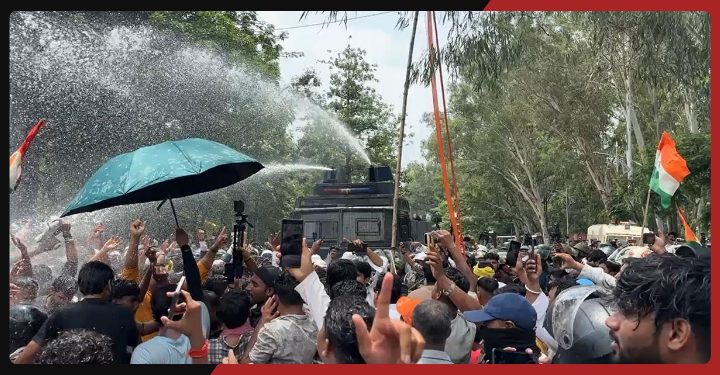
RANCHI: The Jharkhand recruitment examination controversy has moved from negotiations and protest camps to a major confrontation on the streets of Ranchi. On Monday, thousands of students and job aspirants marched towards the state Assembly, demanding action over alleged irregularities in JPSC and JSSC examinations.
The march escalated after protesters crossed or breached police barricades installed near the Assembly route. Security forces responded with water cannons and lathi-charge, while tear gas was also reported.
The latest development reflects the growing intensity of an agitation that has been continuing for weeks.
Students have repeatedly argued that recruitment examinations must be conducted transparently and without irregularities. Their concerns include allegations surrounding several examinations conducted by the state recruitment commissions.
The 14th JPSC Civil Services Examination has emerged as one of the major flashpoints. Student organisations have demanded cancellation of the disputed preliminary examination and an independent CBI probe. Earlier demonstrations in Ranchi saw students carrying placards calling for reform of JPSC and JSSC.
The government has tried to respond through negotiations. Officials have held discussions with student representatives, but the talks have failed to produce a settlement. The principal disagreement has centred on the demand for a CBI investigation.
The government has said that many of the demands raised by students have been addressed. Protesters disagree, arguing that the government’s claim that 98% of demands have been fulfilled does not accurately reflect the unresolved issues.
This disagreement has transformed the protest into a test of political credibility for the state government.
The administration is under pressure to demonstrate that recruitment examinations are being conducted fairly. At the same time, authorities must maintain law and order, particularly around the state legislature.
Before the Assembly march, security arrangements were significantly strengthened. Authorities imposed prohibitory orders around the Assembly and deployed additional police personnel. The objective was to prevent a large gathering from entering the restricted area.
The students, however, proceeded with their planned march.
Once the protesters encountered barricades, tensions rose. Attempts to move past the barricades led to police intervention. Water cannons were used, followed by lathi-charge, while tear gas was also reported.
The confrontation has intensified criticism from different quarters over the handling of the protest. Supporters of the students argue that their concerns deserve serious consideration and that recruitment issues affect the future of thousands of young people. Authorities, meanwhile, are responsible for preventing protesters from entering restricted government premises.
The political opposition has used the controversy to target the government. BJP leaders have repeatedly demanded a CBI investigation into alleged irregularities. BJP MPs also staged a protest in New Delhi over the issue.
Chief Minister Hemant Soren has attempted to position dialogue as the government’s preferred approach. He has emphasized justice and transparency and said that the administration is prepared to engage with students.
Yet the continued protests show that government assurances have not been enough to restore confidence among many aspirants.
For candidates, the controversy has a deeply personal dimension. Government recruitment examinations can determine careers, income and long-term financial stability. Many students spend years preparing for these tests. If an examination is cancelled or its credibility questioned, candidates may have to repeat preparation and face additional uncertainty.
The problem can become even more difficult when recruitment cycles are delayed. Candidates nearing the upper age limit can lose opportunities, while younger candidates may have to postpone other career decisions.
That is why the students’ movement has continued despite the government’s claim of substantial progress.
The Assembly march represents an effort to increase political pressure. By taking their demands directly to the legislature, students have attempted to ensure that the recruitment controversy remains visible.
The confrontation on Monday could now become a turning point. If the government opens a fresh round of negotiations and offers a credible mechanism to address the unresolved demands, tensions may decrease. If the two sides remain locked in their current positions, further protests cannot be ruled out.
The larger lesson from the Jharkhand agitation is that recruitment institutions depend heavily on public trust. Even when investigations are underway, candidates need confidence that the process is impartial and that allegations are taken seriously.
For now, the students remain on the streets, the government remains under pressure, and the recruitment controversy continues to dominate public debate in Jharkhand.