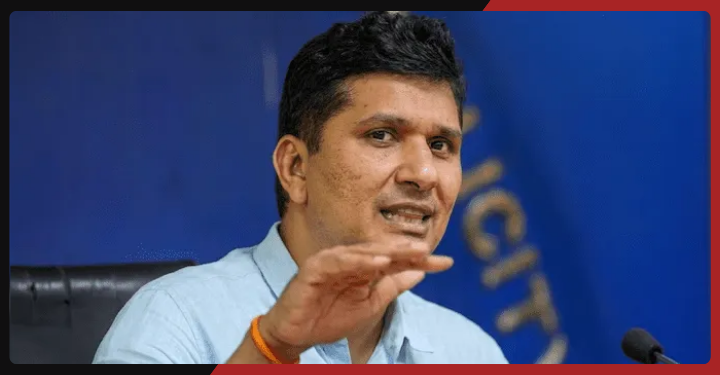
The figure of ₹22,000 crore became a major political talking point after AAP leader Saurabh Bharadwaj invoked it during a dispute over government advertisements in Delhi. His statement came after Lieutenant Governor V K Saxena ordered officials to recover ₹97 crore from the AAP over advertisements that were alleged to have violated government publicity guidelines.
The dispute was not originally about rice, food distribution or a rice procurement scam. The ₹22,000-crore figure cited by Bharadwaj related to his claim about advertising expenditure by BJP-ruled state governments.
That distinction is important because the large figure can easily be misunderstood when separated from the original political context.
Bharadwaj’s argument was that the Delhi government should not be held to a different standard from other governments. He claimed that advertisements issued by BJP-ruled states were also being published in media circulated outside their respective territories.
He therefore questioned why Delhi’s advertising expenditure was being scrutinised while similar publicity by other state governments was not being treated in the same manner.
The argument followed the Lieutenant Governor’s direction to recover ₹97 crore. Authorities had alleged that the Delhi government had spent the money on political advertisements disguised as government publicity.
The controversy was linked to Supreme Court guidelines regulating government advertisements. These guidelines are intended to prevent taxpayer-funded publicity from being used for political advantage.
The issue of government advertisements is complicated because governments genuinely need to communicate with citizens. Public campaigns can provide information about healthcare, education, welfare schemes, environmental measures, transport changes and emergency situations.
At the same time, government advertising can become politically sensitive when advertisements prominently feature leaders or messages associated with ruling parties.
The Delhi government and the Lieutenant Governor’s office disagreed sharply over where the boundary should be drawn.
Bharadwaj’s response was to challenge the political basis of the recovery demand. He argued that the BJP should first explain advertising expenditure by governments it controlled.
Contemporary reports quote him as saying that BJP state governments had spent around ₹22,000 crore on advertisements. That figure should be treated as a political allegation and not as a confirmed finding of financial fraud.
The distinction between an allegation and a proven scam is particularly important when discussing large sums of public money. A claim may require detailed examination of government budgets, advertising contracts, invoices, media purchases and approval procedures before investigators or courts can determine whether any wrongdoing occurred.
The controversy also reflected the wider conflict between the AAP government and the Lieutenant Governor’s office. At the time, the two sides were frequently at odds over administrative and political matters.
For AAP, the advertisement dispute was an opportunity to accuse the BJP of selective targeting. For the BJP and the Lieutenant Governor’s office, the matter concerned the alleged misuse of public funds.
The disagreement also raised a broader question: should a government be allowed to advertise its programmes nationally?
There is no simple answer. A government may legitimately use national newspapers and television channels because its citizens consume those media even when they are physically outside the state. However, the content of such advertisements must still comply with applicable rules.
The controversy therefore involved both geography and purpose. Where an advertisement appears is one issue; why it was issued and what it contains is another.
Bharadwaj’s ₹22,000-crore argument focused on what he considered unequal treatment. His challenge was political: if other governments were advertising beyond their borders, why should Delhi alone face a recovery demand?
The issue gained attention because the alleged figures were dramatically different. ₹97 crore was the immediate amount under dispute, while Bharadwaj invoked ₹22,000 crore as a comparison.
The episode shows how political debates can quickly expand beyond their original administrative questions. A recovery order concerning advertisements became a broader argument about public expenditure by governments across India.
For citizens, the key question is not simply which political party makes the stronger allegation. It is whether public money was spent lawfully, whether advertisements served a genuine public purpose and whether the rules were applied equally.
The available reports establish that Bharadwaj made the ₹22,000-crore claim. They do not establish it as a proven scam.
Therefore, responsible reporting should describe the allegation accurately and distinguish it from verified findings.
The controversy ultimately remains an important case study in the politics of government advertising, public accountability and the continuing confrontation between the AAP and BJP over Delhi’s administration.