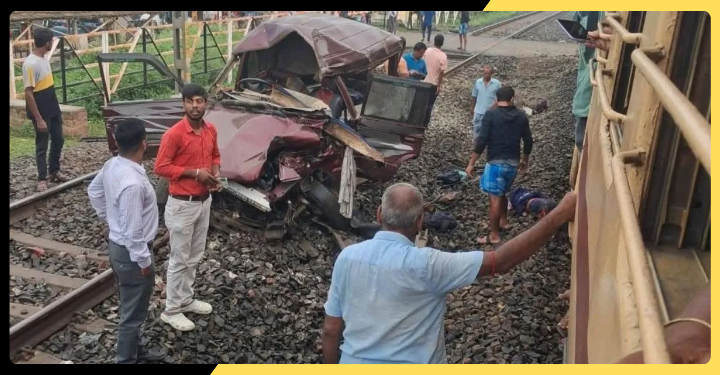
A tragic railway accident in West Bengal’s Murshidabad district claimed the lives of four people, including three school students, after a passenger train collided with a school van at a railway level crossing on Friday morning. The heartbreaking incident has left the local community in mourning and prompted authorities to launch an investigation into the circumstances surrounding the collision.
The accident took place near the Gobindapur railway crossing on the Azimganj–Katwa rail section. According to officials, the school van was transporting children to school when it attempted to cross the railway tracks. At the same time, a passenger train approached the crossing and struck the vehicle with tremendous force. The impact severely damaged the van, trapping several occupants inside and leaving bystanders in shock.
Residents living near the crossing rushed to the accident site immediately after hearing the loud collision. They began rescue efforts even before emergency services arrived, attempting to pull children and the driver out of the wreckage. Police, railway personnel, ambulances, and local volunteers joined the operation soon afterward. Rescue teams worked quickly to transport the injured to nearby hospitals, where doctors provided emergency medical treatment.
Authorities later confirmed that three students and one other person lost their lives in the crash. Several injured children continue to receive treatment, with some reported to be in critical condition. Hospital staff remained on high alert as worried parents and relatives gathered to seek information about their loved ones. The tragedy has deeply affected the community, with schools, local organizations, and residents expressing grief over the loss of young lives.
Following the accident, railway officials initiated a detailed inquiry to determine what led to the collision. Investigators are examining whether all prescribed safety procedures were followed at the level crossing. They are expected to review signalling records, operational logs, eyewitness statements, and other evidence before reaching a conclusion. Officials have stated that action will be taken if negligence or procedural lapses are identified.
The accident has once again brought attention to the importance of railway crossing safety. Transportation experts have often warned that level crossings remain among the most vulnerable points in railway operations, especially where roads and rail lines intersect. Strict adherence to safety rules, proper maintenance of crossing infrastructure, and increased public awareness are considered essential to reducing the risk of such devastating incidents. While the exact cause of the Murshidabad accident has not yet been established, the investigation is expected to provide greater clarity.
The incident also triggered an outpouring of condolences from public representatives and local leaders. Many expressed sympathy for the families who lost their children and called for stronger safety measures to prevent similar accidents in the future. Community members gathered to pay tribute to the victims, while social media was flooded with messages mourning the tragic loss.
Railway authorities have assured the public that the investigation will be conducted thoroughly and transparently. They have emphasized that the findings will help determine whether improvements are required in operational procedures or crossing management. Until the official report is released, authorities have urged the public to avoid speculation and rely only on verified information.
The Murshidabad railway crossing tragedy serves as a painful reminder of the devastating consequences that can result from accidents involving trains and road vehicles. As the affected families cope with an unimaginable loss, the incident has renewed calls for enhanced railway safety infrastructure, stricter compliance with operational protocols, and continuous efforts to protect passengers and schoolchildren travelling near railway crossings. The outcome of the investigation is expected to play an important role in shaping future safety measures aimed at preventing similar tragedies.