
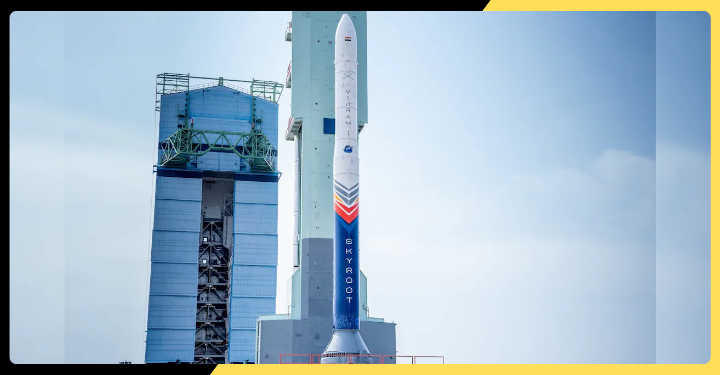
The successful orbital mission of Vikram-1 has placed Skyroot Aerospace among the most promising private space companies in India. The launch is a landmark achievement, proving that an Indian startup can independently design, build, and successfully deploy an orbital-class rocket. It is a moment of national pride and an important milestone for India’s growing commercial space sector. Yet, for Skyroot, the mission represents not the finish line but the starting point of a much larger challenge. The company’s next frontier is scaling its business, expanding its market presence, and helping shape India’s private space industry into a globally competitive ecosystem.
Space technology has entered a new commercial era. Governments are no longer the only organizations launching satellites or investing in space exploration. Today, telecommunications companies, Earth observation firms, defense organizations, research institutions, and even agricultural businesses depend on satellite technology for a wide range of applications. This growing reliance on space-based services has created unprecedented demand for reliable and affordable launch providers.
Skyroot was founded to address this emerging opportunity. Established by former engineers from the Indian Space Research Organisation (ISRO), the company has focused on developing cost-effective launch vehicles specifically designed for the rapidly expanding small satellite market. By using lightweight composite materials, modular rocket architecture, and advanced 3D-printing techniques, Skyroot aims to reduce manufacturing complexity while improving production efficiency.
The success of Vikram-1 validates the company’s engineering capabilities. Reaching orbit requires extraordinary precision in propulsion, navigation, structural engineering, and mission control. Completing such a mission demonstrates that Skyroot possesses the technical expertise necessary to compete in one of the world’s most demanding industries. However, commercial success requires far more than technical excellence.
Scaling a launch business involves building the capacity to manufacture rockets consistently and efficiently. Unlike demonstration missions, commercial operations demand predictable production schedules, standardized manufacturing processes, and rigorous quality control. Customers expect launch providers to deliver missions on time without compromising safety or reliability. Meeting these expectations becomes increasingly challenging as production volumes grow.
One of Skyroot’s immediate priorities will likely be increasing launch frequency. Regular launches generate revenue, strengthen customer relationships, and build operational experience. Every successful mission enhances the company’s credibility while providing valuable data for improving rocket performance and reducing operational costs. Establishing a reliable launch cadence will therefore be critical for long-term business growth.
The expanding global small satellite market offers significant commercial opportunities. Modern satellites have become smaller, lighter, and less expensive while delivering increasingly sophisticated capabilities. These satellites support broadband internet, climate monitoring, disaster management, navigation, scientific research, precision agriculture, and national security. Industry forecasts indicate that thousands of small satellites will be launched over the next decade, creating sustained demand for dedicated launch services.
Dedicated launch vehicles provide several advantages compared with traditional rideshare missions. Customers gain greater flexibility in selecting launch windows, orbital destinations, and mission parameters. This flexibility is particularly valuable for organizations operating time-sensitive commercial or scientific missions. Skyroot’s launch vehicles are designed to serve this specialized market, giving the company an opportunity to differentiate itself from larger launch providers.
Despite these opportunities, international competition remains intense. Established companies have invested heavily in reusable rockets, automated manufacturing systems, and vertically integrated production facilities. These innovations reduce launch costs and improve operational efficiency, allowing larger companies to compete aggressively on pricing. Skyroot must therefore continue investing in research and development to ensure its technology remains competitive in an evolving marketplace.
Financial sustainability will play a defining role in the company’s future. Developing rockets requires continuous investment in engineering, testing, manufacturing infrastructure, launch facilities, regulatory compliance, and skilled personnel. Venture capital and private equity have supported many early-stage space companies, but long-term investors increasingly expect measurable financial performance. Revenue growth, recurring commercial contracts, operational efficiency, and profitability will become key indicators of Skyroot’s success.
Government policy has created favorable conditions for private space companies in India. Regulatory reforms have encouraged greater participation from startups while expanding access to testing facilities, launch infrastructure, and technical collaboration. Organizations supporting private space enterprises have also helped streamline regulatory processes and encourage innovation. Continued government support could accelerate the development of a vibrant commercial space ecosystem capable of competing internationally.
Another important area for growth is international expansion. Many countries are investing in satellite programs but lack domestic launch capabilities. By offering affordable, dependable, and flexible launch services, Skyroot can attract customers from emerging space markets across Asia, Africa, Europe, and Latin America. Building strategic partnerships with international satellite manufacturers and research organizations could further strengthen the company’s global presence.
Diversification may also become an essential part of Skyroot’s long-term strategy. Beyond launch services, the company could expand into satellite integration, orbital transfer vehicles, propulsion systems, mission management, and future in-space logistics. Offering comprehensive space solutions would not only generate additional revenue but also deepen relationships with commercial customers.
Innovation must remain at the heart of Skyroot’s growth strategy. The aerospace industry evolves rapidly, with new technologies emerging in propulsion, artificial intelligence, advanced materials, autonomous systems, and reusable launch vehicles. Continuous investment in research and product development will be essential to maintain competitiveness and meet changing customer expectations.
The successful Vikram-1 mission has already secured Skyroot’s place in the history of India’s private space sector. It has demonstrated that Indian startups possess the technical expertise and entrepreneurial spirit needed to compete globally. Yet the company’s greatest opportunity lies ahead. Scaling operations, attracting international customers, maintaining operational excellence, and achieving financial sustainability will determine whether Skyroot becomes a long-term leader in the global space economy.
As India seeks to expand its influence in commercial space, companies like Skyroot will play a central role in shaping the nation’s future. Vikram-1 may have opened the door to orbit, but the next frontier is building a world-class space enterprise capable of delivering innovation, economic growth, and global competitiveness for decades to come.